



What is A/B testing in running ads? This is the core testing method that helps Performance Marketers find the ad creative with the highest conversion rate. If you are looking to optimize cost per acquisition (CPA) and sustainably boost sales, join MEWA to break down the concept, key elements to test, and the step-by-step process of a/b testing below!
What Is A/B Testing? Core Operating Principles
What is A/B testing? A/B testing (or Split Testing) is a method of comparing two versions of an ad or webpage (Version A and Version B) running simultaneously side-by-side. By randomly dividing the audience, advertisers can determine which version achieves a higher conversion rate and better overall performance based on real-world data.
The success of an a/b testing campaign lies in how you control factors throughout the experiment. To ensure the collected data achieves maximum accuracy and truly reflects customer behavior, mastering the core mechanics is mandatory.
The 3 core operating principles when running an A/B test
- Test Only One Variable at a Time (One Variable at a Time): Keep all elements of Version A (the control) identical and change exactly 1 detail in Version B (the variation) — for example, keep the image, target audience, and budget the same, while modifying only the headline.
- Ensure Data Fairness: Split traffic randomly and evenly between both versions during the exact same timeframe, eliminating external noise such as weather or market fluctuations.
- Identify the Winning Factor Clearly: Because only 1 variable was changed, when Version B performs better, you can confirm with 100% certainty where that improvement originated (whether from a better image, a more compelling headline, or a more engaging CTA button).
5-Step Process To Implement Standard A/B Testing
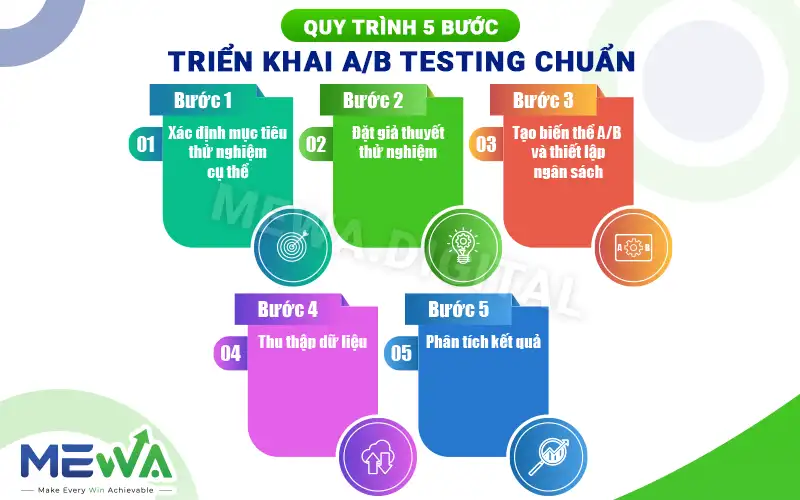
For an a/b testing campaign to deliver real value rather than just endless trial and error, you need to follow a structured workflow. Here is the 5-step performance-standard process to help you optimize ads based on accurate data.
Step 1: Define Specific Testing Goals
Before starting, clearly define the key performance indicator (KPI) you want to improve. Setting the right goal determines which elements you should bring into testing.
- Increase Click-Through Rate (CTR): Prioritize testing Images, Videos, or Headlines.
- Increase Orders/Registrations (Leads): Prioritize testing Landing Pages, Lead Forms, or Call-to-Action (CTA) buttons.
- Decrease Cost Per Acquisition (CPA): Test an overall combination of Creatives and Target Audiences.
Step 2: Formulate A Testing Hypothesis
A good test always begins with a grounded hypothesis. A hypothesis helps set a clear direction for why the new variation might perform better than the original.
“If I change [Variable X], then [Metric Y] will improve because of [Reason Z].”
Step 3: Create A/B Variations And Set Up Budget
In this step, proceed to create the Control (Version A) and Variation (Version B) based on your hypothesis.
- Stick to the One Variable Principle: Ensure Version A and Version B differ only by the single factor you want to measure.
- Allocate Budget Evenly: Set equal budgets for both versions so the system distributes data fairly, preventing one side from being suppressed in delivery.
Step 4: Collect Data (Gather A Sufficient Sample Size)
Once the campaign is launched, be patient and allow the algorithm to run and collect data.
- Minimum Running Time: Run the campaign continuously for 3 to 7 days. Running it too short (under 3 days) will not gather enough data, while running it too long can waste budget if an underperforming variation keeps spending money.
- Do Not Interfere Mid-Way: Toggling ads on/off or abruptly tweaking budgets during testing will disrupt the algorithm and corrupt the entire test dataset.
Step 5: Analyze Results & Scale The Winning Ad
Once you have gathered enough data to achieve statistical significance, compare metrics between both versions.
- Identify the Winning Ad: Choose the version that achieves the best target metric (highest CTR or lowest CPA).
- Next Steps: Turn off the low-performing version and consolidate your full budget to scale up the Winning Ad. Simultaneously, use this winning ad as the “new control” to prepare for subsequent rounds of a/b testing.
How To Implement Facebook Ads A/B Testing?
Facebook Ads is one of the most powerful platforms for ad experimentation today. To implement a/b testing facebook, you can choose between using the built-in testing tool in Ads Manager or configuring your experiments manually.
Cách tạo chiến dịch a/b testing facebook bằng công cụ có sẵn
Creating A Facebook A/B Test Campaign Using Built-In Tools
Facebook provides an automated A/B Test feature directly inside Ads Manager, allowing you to set up and measure tests accurately according to Meta’s algorithms.
- Initialize: Inside Ads Manager, create a new campaign or select an existing campaign/ad set.
- Enable A/B Test Feature: At the Campaign or Ad Set level, toggle the “A/B Test” switch to turn on the feature.
- Select Test Variable: Facebook will prompt you to pick the key element you want to compare (Creative, Primary Text, Audience, or Placements).
- Create Variations: Upload content or configure targeting parameters for Version A and Version B.
- Configure Budget & Duration: Set the total testing budget and select your schedule (recommended minimum of 3 to 14 days).
Manual A/B Testing Method On Facebook Ads
If you prefer more flexibility when managing individual group budgets or want to quickly test multiple ad variations simultaneously, you can apply the manual a/b testing facebook approach.
- Testing Audience: Create 1 Campaign Create 2 Ad Sets with identical budgets and identical ads Modify only the target audience in each Ad Set.
- Testing Creative/Content: Create 1 Campaign Create 1 Ad Set Create 2 Ads inside Ad A remains as the control, while Ad B modifies only 1 detail (Image/Video/Headline).
Real-World A/B Testing Examples In Campaign Optimization
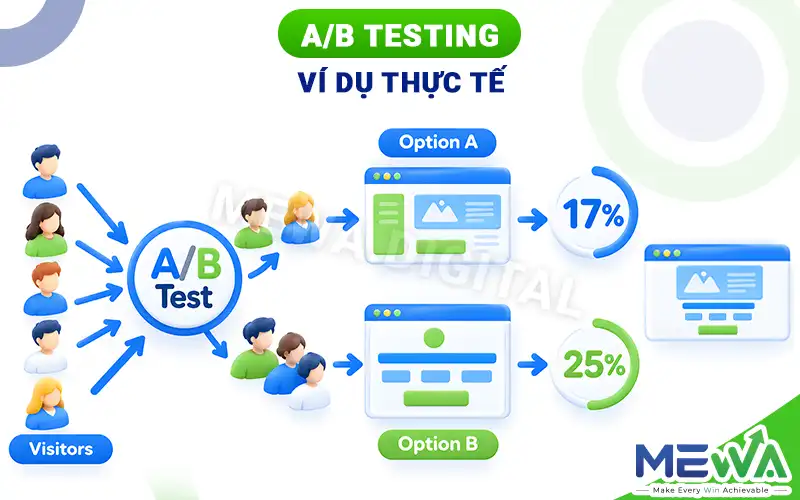
Below are two A/B testing examples simulating real-world ad scenarios to help you visualize how to compare variations and identify the message that resonates best with your target audience.
A/B Testing Example 1: Testing Creative Formats (Carousel Static Image vs. Video Animation)
- Scenario: A phone screen protector brand aims to scale online sales volume.
- Testing Setup:
- Version A (Control): Uses a horizontal swipe Carousel featuring key selling points: privacy anti-peeping, impact resistance, and anti-fingerprint coating.
- Version B (Variation): Uses a 15-second Video Animation simulating a real-life situation where someone snoops on phone messages in public, followed by a simple installation demo.
- Controlled Elements: Target audience, headline, and the “Shop Now” call-to-action (CTA) button remain identical.
Takeaway: Problem-solving products require clear visual demonstration. Video animation lets customers instantly spot the pain point and its solution within the first 3 seconds. This significantly boosts click-through rate (CTR), improves watch time, and enables the ad algorithm to deliver lower overall acquisition costs.
A/B Testing Example 2: Testing Communication Angles (Pain Point vs. Promotional Offer)
- Scenario: A conversational English training center runs a lead generation campaign targeting working professionals.
- Testing Setup:
- Version A (Promotional Angle): “Enroll in English today – Get 40% off tuition instantly!”
- Version B (Pain Point Angle): “Missing out on promotion opportunities and your dream salary just because you can’t speak English fluently?”
- Controlled Elements: Intro video, landing page, and target audience (working adults aged 24–35) remain identical.
→ Takeaway: Working professionals are rarely motivated by minor discounts unless they feel an urgent need. The headline in Version B directly addresses career anxiety—a pain point with far greater emotional weight than price savings alone. This prompts immediate action rather than hesitation.
Key Elements To Test In Ad Campaigns
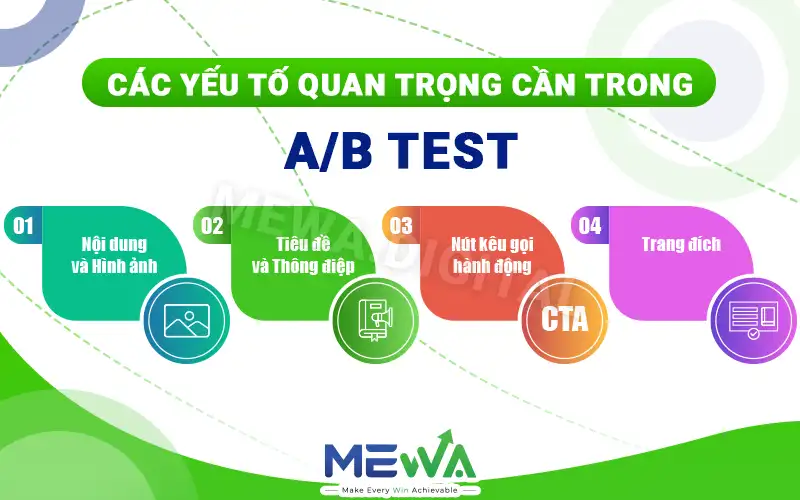
Testing broadly without focus will only drain your budget in any ad campaign. To quickly discover optimal solutions, prioritize testing these 4 core elements that directly influence user behavior and conversion rates.
Creative (Visuals & Video Format)
Creative is the first element users notice while scrolling through social media platforms. It accounts for 60%–70% of an ad campaign’s success.
- Video vs. Static Image: Compare whether your target audience prefers short-form video (Reels, TikTok) or browsing static images and Carousels.
- Imagery & Layout: Test the performance difference between real product photos, designed graphics, or User Generated Content (UGC).
- Color Schemes & Fonts: Tweak dominant brand colors to find the visual palette that best captures attention.
- Video Thumbnails: For video ads, the initial frame (Thumbnail) determines whether users stop to watch or scroll past.
Ad Copy & Headlines
While visuals grab user attention, compelling ad copy persuades them to convert. Conducting a/b testing across different writing styles helps you tap directly into various consumer mindsets.
- Short vs. Long Headlines: Test whether concise, direct headlines or intriguing, story-driven headlines yield a higher click-through rate (CTR).
- Copy Angles: Compare addressing pain points (e.g., “Tired of recurring breakouts?”) against highlighting benefits/offers (e.g., “Get 50% off acne treatment”).
- Primary Text Structure: Experiment with brief bullet points versus long-form educational copy.
Call-To-Action (CTA) Buttons
The CTA button serves as the final touchpoint driving users toward the desired action. Even minor copy tweaks on a button can create noticeable differences in conversion rates.
- Standard CTA Options: Measure relative performance between buttons like “Shop Now”, “Sign Up”, “Learn More”, or “Get Offer”.
- CTA Psychology: Low-commitment buttons (like “Learn More”) typically achieve higher CTR during cold traffic prospecting, whereas high-intent buttons (like “Shop Now”) perform better during retargeting.
Landing Page
The conversion journey continues after a user clicks your ad. No matter how strong your ad creative is, a poor landing page leads to high bounce rates.
- Interface & Layout: Test different information structures, light vs. dark themes, or buy button placements.
- Lead Form Fields: Test short forms (requesting only Name + Phone Number to minimize friction) against long forms (collecting Email + Address to qualify lead quality).
- Hero Section Headline: Ensure the message on your landing page perfectly matches and aligns with the specific ad copy users clicked on.
Conclusion
Understanding what is a/b testing and adhering strictly to the “one variable at a time” principle are the keys to mastering any performance marketing campaign. Apply this structured 5-step testing framework to boost conversion rates, slash ad costs, and deliver sustainable business growth!
