



SKU numbers serve as critical identifiers that help businesses classify, track, and manage inventory accurately. Lacking internal product code standardization from the start easily leads to stock loss, order packing errors, and cash flow balance issues.
In this article, MEWA will help you thoroughly understand what is SKU, what is a product SKU, the structure of a standardized code, and effective warehouse management methods using these identifiers.
What is SKU? What is a product SKU?
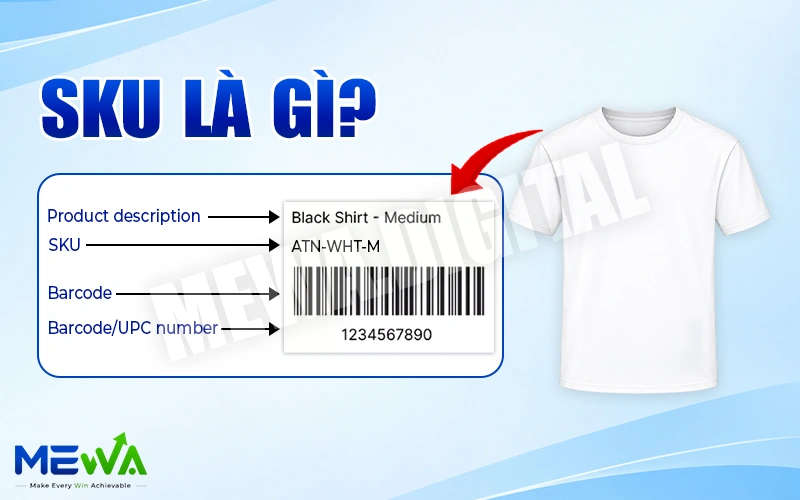
SKU (short for Stock Keeping Unit) is an internal inventory classification unit. A SKU number is understood as an internal product code consisting of alphanumeric characters used to uniquely identify specific merchandise items.
What is a product SKU? It is a string of characters that details each distinct product option based on attributes such as brand, category, color, size, or material.
Notably, SKU codes are independently designed and specified by each business based on internal management needs, without relying on external regulatory bodies or adhering to mandatory international standards.
For example: A fashion retail business sells a women’s t-shirt line. Although sharing the same design, this item is produced in 2 colors (White, Black) and 2 sizes (M, L). The business creates 4 distinct SKU number strings as follows:
- Women’s t-shirt white, size M: ATN-WHT-M
- Women’s t-shirt white, size L: ATN-WHT-L
- Women’s t-shirt black, size M: ATN-BLK-M
- Women’s t-shirt black, size L: ATN-BLK-L
Similarly in the consumer electronics sector, a Samsung top-load washing machine with a 7.5 kg capacity produced in 2016 for the Vietnamese market is assigned the detailed SKU identifier WW75K5210YW/SV.
What is SKU variant? Why does each variant need a unique code?
What is SKU variant? It refers to using specific SKU number codes to differentiate products or variants based on detailed attributes. Common attributes include color, size, volume, material, style, version, or packaging specification.
For instance, a desk model might have the following versions:
- White desk 60x120x75
- Black desk 47x120x75
- White desk 47x120x75
- Black desk 60x120x75
If only a single general SKU number is assigned across all items, a business cannot determine which specific variant remains in stock, which is selling fast, or which is out of stock. Therefore, every distinct combination of major attributes should receive a dedicated SKU number.
Assigning codes by SKU variant brings key operational benefits:
- Detailed Inventory Tracking: Know exact stock levels for every color, size, or version.
- Minimizing Picking Mistakes: Warehouse staff rely on the exact SKU number to pick correct items.
- Accurate Order Processing: Essential for orders containing multiple similar items.
- Analyzing Sales Performance: Identify which specific SKU variant customers prefer most.
- Streamlined Replenishment: Restock exact missing items rather than reordering based on guesswork.
What information does a SKU number usually contain?
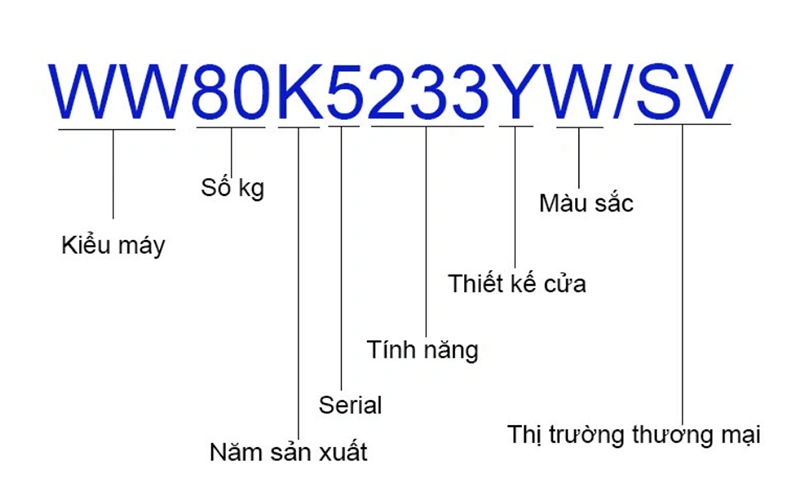
A scientifically structured SKU number system enables managers to read and understand core product attributes at a glance without complex database lookups. Specifically:
- Brand Name: Abbreviation representing origin or distributor (e.g., MW for MEWA, AP for Apple).
- Product Category: Identifies general product groupings (e.g., TS for T-Shirt, WM for Washing Machine).
- Product Attribute Description: Material (cotton, silk), style (long sleeve, short sleeve), or feature line (premium, basic).
- Color: Abbreviated color names (e.g., BLK for Black, RED for Red, WHT for White).
- Size or Packaging Spec: Represents size specifications (S, M, L), volume (50ML, 100ML), or weight (7KG, 10KG).
- Warehouse Location: Code indicating branch location or rack position (e.g., HN for Hanoi warehouse, HCM for Ho Chi Minh warehouse, A1 for Rack A1).
- Batch Code or Sequence: Sequential numbers distinguishing product versions or intake batches.
Depending on business scale and industry characteristics, companies can incorporate all or select fewer fields to keep the SKU number concise.
The importance of SKU in logistics & warehouse management
The SKU system serves as foundational data that empowers businesses to control merchandise across the entire logistics framework. From receiving to order fulfillment, the SKU number is used for verification and data updates.

Rapid visual product identification
Unlike barcodes that only present vertical lines, this identification method utilizes human-readable alphanumeric strings. Warehouse personnel quickly master reading and identifying product details on labels without relying on handheld scanners at every step.
Reducing errors during receiving and dispatch
During receiving, the SKU number verifies physical stock against purchase invoices. If codes mismatch, staff double-check prior to updating system counts.
During dispatch, the SKU number confirms correct item picking. This is crucial for high-variant categories like fashion, cosmetics, accessories, electronics, or consumer goods.
Dispatching incorrect SKU codes causes severe operational friction:
- Delivering incorrect products to customers.
- Incurring return requests.
- Wasting extra shipping expenses.
- Distorting stock counts.
- Losing time resolving data errors.
Controlling inventory levels
Every count adjustment per SKU number records directly on the management system. Routine cycle counts by SKU reveal discrepancies between physical stock and software records early, isolating causes like clerical errors or internal shrink.
Data synchronization across multi-channel sales
When expanding stores across e-commerce marketplaces (Shopee, TikTok Shop) and standalone websites, applying a unified SKU number structure allows central software to auto-deduct stock across all channels when a new sale occurs anywhere.
What is SKU in marketing? How SKU supports sales activities
What is SKU in marketing? SKU is not an ad metric or standalone marketing tool. However, in marketing and e-commerce operations, the SKU number connects product data directly with sales performance.
Through each SKU number, businesses evaluate individual product or variant performance following promotional campaigns.
For example, an ad campaign launching a new t-shirt line generates high order volume. Tracking performance via SKU number reveals:
- Which design receives the highest orders.
- Which color variant converts best.
- Which size frequently runs out of stock.
- Which SKU gets high views but low conversions.
- Which SKU variant is optimal for further promotional spending.
Marketing teams collaborate with warehouse and sales units using these insights to make informed decisions—promoted high-stock items, adjusting content for slow-moving stock, or pausing ads for low-stock items.
How to set up a product SKU number that is easy to remember and manage
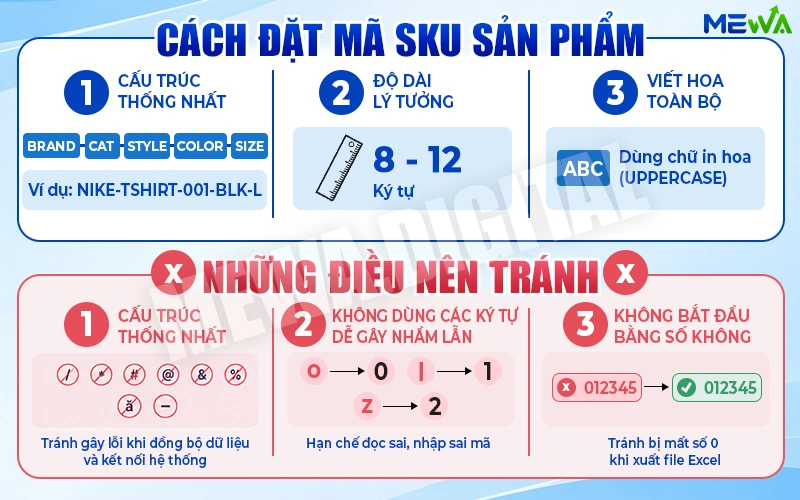
Building a sustainable SKU system requires clear coding rules from the outset:
- Consistent Structure: Standardize information fields in a fixed sequence across all products. Example: [Brand] – [Category] – [Style] – [Color] – [Size].
- Length Limits: Ideal length ranges between 8 to 12 characters. Extremely short codes lack attribute detail, while overly long codes clutter printed labels.
- Uppercase Characters: Use UPPERCASE letters across all text fields for database uniformity.
Key formatting errors to avoid
- Do not use special characters or spaces: Avoid /, *, #, @, &, %, or blank spaces. Management software and API integrations frequently throw processing errors when encountering these characters.
- Avoid confusing characters: Do not place letter O next to number 0, letter I next to number 1, or letter Z next to number 2, as warehouse workers easily misread them.
- Do not start codes with number 0: When exporting data to Excel spreadsheets for reporting, default auto-formatting deletes leading zeros, causing SKU number mismatches.
Optimal warehouse management using SKU numbers
To maximize warehouse space and operational efficiency using SKU codes, apply systematic management practices:
Organizing warehouse locations by SKU number
Store items with identical SKU codes in dedicated shelf slots. For items with similar visual appearances but different codes (e.g., same color, different sizes), place them in separate bins with clear labels to prevent picking errors.
Classifying inventory by velocity (ABC Analysis)
- Group A SKUs (Fast-moving): Position near dispatch doors at waist height for quick picking.
- Group B SKUs (Medium-moving): Store on higher shelves or deeper within aisles.
- Group C SKUs (Slow-moving): Place on top shelves or farther storage areas.

Setting minimum reorder points
Establish a safety stock threshold for every SKU number. When actual stock hits this threshold, the system triggers alerts for procurement teams to reorder proactively, preventing stockouts.
Implementing specialized inventory software
For businesses managing hundreds of SKU codes, manual logs or spreadsheets introduce heavy error margins. Adopting operations and finance management solutions like Meshop within the MEWA ecosystem automates code generation, barcode stocktaking, and real-time inventory reporting.
Difference between SKU and UPC/Barcode
In daily operations, professionals often confuse a SKU number with a UPC or Barcode. While all serve item identification purposes, their nature and scope differ fundamentally.
Detailed comparison between SKU and UPC/Barcode
| Criteria | SKU Number (Stock Keeping Unit) | UPC / Barcode (Universal Product Code) |
| Nature | Internal custom code set by the business. | Global standard code issued by GS1. |
| Usage Scope | Internal company operations only. | Worldwide commercial recognition. |
| Length & Structure | Flexible alphanumeric, customizable length. | Fixed 12 digits (UPC) or 13 digits (EAN). |
| Human Readability | Human-readable and visually decipherable. | Requires specialized barcode scanners. |
| Setup Cost | Free, managed internally. | Requires registration and maintenance fees. |
| Primary Purpose | Internal sorting, inventory tracking, cost accounting. | Retail checkout scanning, supply chain tracking. |
A product circulating in the market can carry both identifiers simultaneously. The UPC/Barcode printed on packaging handles POS register scanning, while the internal SKU number tracks specific variants inside software systems.
Conclusion
A well-structured SKU system enables businesses to maintain total inventory control from receiving to final fulfillment. As product catalogs and sales channels expand, manual SKU management becomes unmanageable. Businesses must standardize code creation, sync data, and link SKU structures directly into warehouse and sales workflows.
With MEShop in the MEWA ecosystem, centralizing product data and operations on a single unified platform empowers businesses to control stock, laying a solid foundation for future scaling!
