



Are you looking for ways to control your marketing budget so that every expense yields a profit? ROI is the backbone metric that helps you accurately evaluate business performance. Join MEWA to explore what is ROI, what metric ROI is, the exact ROI calculation formula, and the easiest ways to optimize ROI in TikTok Ads for beginners right below!
What Is ROI?
ROI stands for Return on Investment. It is a metric used to measure the financial efficiency returned relative to the total cost spent on a business activity or marketing campaign. So, what kind of metric is ROI that every business professional needs to track? Put simply, it is a “gauge” that directly reflects a company’s profit picture:
- ROI > 0: The campaign is profitable; the revenue returned is higher than the costs spent.
- ROI = 0: The campaign breaks even.
- ROI < 0: The campaign is operating at a loss; strategy adjustments are required.
The Most Standard and Accessible ROI Formula
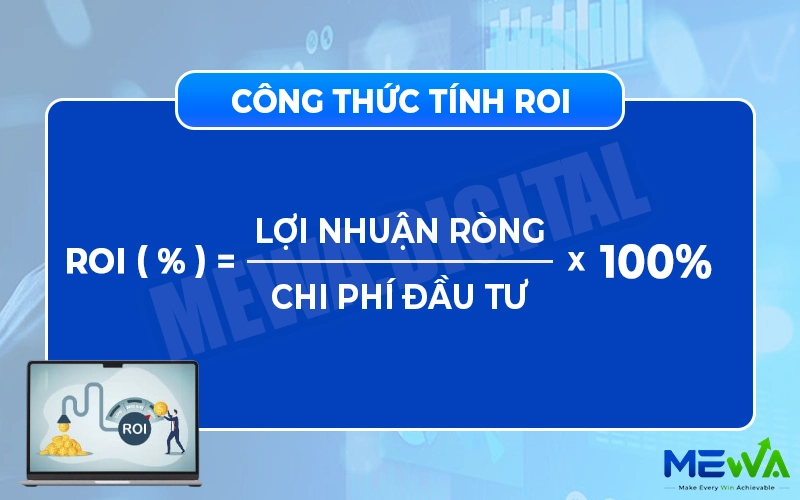
To accurately determine the effectiveness of a campaign, you can apply the basic ROI calculation formula below:
ROI = ((Revenue – Cost) / Cost) x 100%
Or more simply:
ROI = (Net Profit / Investment Cost) x 100%
Where:
- Net Profit: The value the business receives from the investment.
- Investment Cost: The total cost spent on that activity.
- ROI: Return on Investment, calculated as a percentage.
*Example: You spend 10,000,000 VND on an ad campaign and generate 25,000,000 VND in revenue.
In this case, ROI = ((25,000,000 – 10,000,000) / 10,000,000) x 100% = 150%.
→ This means the campaign yielded a 150% profit relative to the invested capital.
For beginners, a common mistake is accounting only for direct ad spend. To get the most accurate results, you need to factor in hidden costs such as:
- Cost of Goods Sold (COGS)
- Personnel, design, and content creation expenses
- Supporting tools and software costs
Factors Influencing the ROI Metric

To optimize return on investment, focusing solely on increasing revenue is not enough. You need to clearly understand the core factors that directly impact ROI to make appropriate adjustments.
Investment Costs and Hidden Expenses
Cost is the variable with the largest impact on ROI results. When total costs rise while revenue remains unchanged, the ROI metric drops significantly. Beginners often make the mistake of accounting only for direct ad spend while ignoring hidden costs such as:
- Product sourcing costs and Cost of Goods Sold (COGS).
- Personnel, operations, and content creation expenses.
- Costs for marketing support tools and software.
Conversion Rate (CRO)
The conversion rate reflects the percentage of users who complete a purchase after viewing an ad or visiting a website. The higher the conversion rate, the greater the revenue generated from the same ad budget, which drives up the ROI metric substantially.
Average Order Value (AOV)
For the same number of orders sold, if you can increase the average order value (AOV) through cross-selling or up-selling strategies, total revenue will increase while customer acquisition costs remain unchanged. This has a direct and positive impact on ROI.
Traffic Volume and Target Audience Quality
High traffic volume only brings in profit if it consists of qualified prospective customers with genuine interest. Reaching the wrong target audience results in wasted impression or click costs without generating sales, severely damaging the campaign’s financial efficiency.
User Experience and Product Quality
No matter how excellent a marketing campaign is, it cannot maintain a high ROI if the product quality is poor or the purchasing process is complex. A good user experience helps increase repeat customer purchases (Customer Lifetime Value – CLV), allowing businesses to earn long-term profits without incurring additional initial advertising costs.
What Is ROI in TikTok Ads?
TikTok is a booming platform for content creation and social commerce. However, to ensure your ad campaigns deliver real business performance rather than just vanity metrics, you must understand the concept of ROI on this platform.
Definition of the ROI Metric in TikTok Advertising
What is ROI in TikTok Ads? This is a metric that measures the actual financial efficiency derived from paid advertising campaigns on TikTok. It reflects the relationship between the net profit generated from TikTok customers and the total actual budget you spent on the entire campaign.
Differentiating ROI and ROAS in TikTok Ads
Many beginners running TikTok ads often confuse ROI (Return on Investment) with ROAS (Return on Ad Spend):
- ROAS (Return on Ad Spend): Calculated by dividing Revenue by the Ad Spend displayed in TikTok Ads Manager. ROAS only reflects the technical performance of an ad creative.
- ROI (Actual Return on Investment): Calculated by dividing Net Profit (Revenue minus Cost of Goods Sold, Ad Spend, Shipping, Operations, etc.) by Total Investment.
*Example:
A TikTok ad reports ROAS = 3 (spending 1 million in ad costs yields 3 million in revenue). However, if product cost and operational expenses total 2.5 million, you are actually operating at a loss. In this scenario, ROAS is positive, but ROI is negative.
ROI Optimization Tips for Businesses

The ultimate goal of all marketing activities is to increase return on investment. To optimize ROI sustainably without constantly raising your investment budget, businesses can implement the key strategies below.
Conversion Rate Optimization (CRO) on Sales Channels
Increasing traffic is often very expensive, but increasing conversion rates allows you to generate more revenue from the same volume of existing traffic.
- Optimize landing page experience: Ensure fast loading speeds, a mobile-friendly interface, and a clear call-to-action (CTA) message.
- Simplify the checkout process: Reduce unnecessary steps to limit cart abandonment.
Continuous A/B Testing
Never make marketing decisions based on intuition. A/B testing helps you find the most optimal solution at the lowest cost:
- On paid ads (Facebook, TikTok Ads): Test various video formats, images, headlines, and target audience segments to select ad creatives with the best conversion costs.
- On website content/SEO: Test different headline placements, illustrations, or buy button positions to improve click-through and engagement rates.
Improving Customer Lifetime Value (CLV)
Acquiring a new customer is often 5 to 7 times more expensive than retaining an existing one. Increasing customer lifetime value helps a business’s ROI grow exponentially:
- Build cross-selling and up-selling strategies: Suggest complementary products or upgrade packages right when the customer decides to purchase.
- Focus on post-purchase customer care: Use Email Marketing, loyalty programs, or Zalo/CRM care to encourage customers to return and shop frequently.
Automating and Eliminating Inefficient Costs
Optimizing ROI is not just about increasing revenue; it is also about cutting hidden leaks in operational expenses:
- Apply automation tools: Use sales management software, automated customer service chatbots, or post-scheduling tools to save on staffing costs.
- Periodically audit marketing channels: Decisively cut or pause campaigns, keywords, or ad channels that consistently deliver negative ROI to consolidate budget into more effective channels.
Conclusion
Understanding what is ROI, mastering the ROI calculation formula, and knowing how to measure ROI in TikTok Ads serve as the master key to taking full control of your finances and optimizing every marketing campaign. Start tracking and measuring this metric today to ensure every budget dollar spent yields maximum profit for your business!
