



Running ads is easy, but controlling your CPM metric is a challenge not everyone can master. In this article, MEADS will explain in detail what CPM is, how to interpret this metric, and actionable tips to drive your CPM down to the lowest possible level. Don’t miss out if you want to optimize your advertising costs as much as possible!
What Is the CPM Metric?
CPM stands for Cost Per Mille (“Mille” means one thousand in Latin). It is a metric used to measure the cost per 1,000 impressions of an advertisement across digital platforms such as Facebook, Google Display Network (GDN), TikTok, or YouTube.
When you run CPM – based ad campaigns, you pay for the number of times your ad appears on users’ screens, regardless of whether they click on the ad or make a purchase.
Note: Impressions are different from Reach. Reach refers to the number of unique users who see your ad, while Impressions represent the total number of times the ad is displayed (a single user can view an ad multiple times).
Most Accurate Formula to Calculate CPM
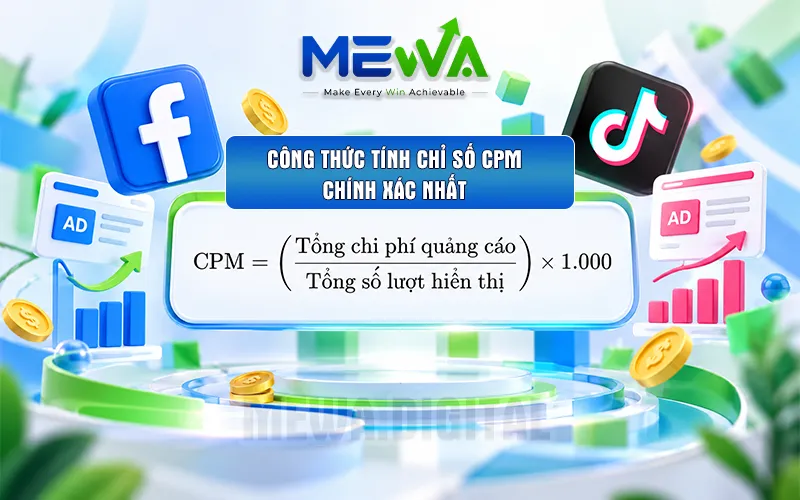
To calculate CPM, apply the following basic formula:
Practical example:
You spend 500,000 VND to run a Facebook ad. After the campaign ends, the ad reaches 100,000 impressions.
Applying the formula: $\text{CPM} = (500,000 / 100,000) \times 1,000 = 5,000\text{ VND}$
→ Thus, the CPM of the campaign is 5,000 VND, meaning the business spent an average of 5,000 VND for every 1,000 ad impressions displayed.
What are the pros and cons of CPM advertising in marketing?
Every ad pricing model has two sides. Clearly understanding the pros and cons helps you make appropriate strategic choices.
Pros
- Cost optimization when scaling reach: If the ad content is engaging and has a high click-through rate (CTR), the actual cost per click will be much cheaper compared to running CPC.
- Rapidly increase brand awareness: Helps the brand appear continuously in front of potential customers in a short period.
- Easy budget forecasting: You can easily calculate the amount of impressions based on a fixed budget.
Cons
- Conversion risks: You still have to pay for impressions even if users are not interested, do not click, or do not purchase.
- Vulnerable to fake clicks/ghost impressions: Some platforms may display ads in low-visibility positions (bottom of the page) but still charge money.
Comparison Table: CPM, CPC, and CPA
To avoid confusion between these common Digital Marketing metrics, you can refer to the quick comparison table below:
| Metric | Full Name | Pricing Model | Best Suited For Goal |
| CPM | Cost Per Mille | Every 1,000 impressions | Brand Awareness |
| CPC | Cost Per Click | Every click on the ad | Driving Traffic / Consideration |
| CPA | Cost Per Action | Every specific action (form fill, purchase) | Increasing Conversions / Sales |
| CTR | Click-Through Rate | Percentage of clicks on the ad = (Total Clicks / Total Impressions) $\times$ 100% | Measuring how engaging the ad content, images, and videos are to customers |
| ROAS | Return On Ad Spend | Revenue generated from ads = (Total Ad Revenue / Total Ad Spend) | Measuring actual revenue effectiveness and campaign profitability |
When Should You Choose a CPM Ad Campaign?
Not every campaign is suitable for CPM. CPM is best suited for campaigns that prioritize reach and brand awareness, rather than focusing directly on clicks or orders. Therefore, prioritize choosing CPM in the following cases:
- Launching new products/services: Need to reach as many people as possible with your brand.
- Advertising in premium placements: Banner ads on major news sites, the YouTube homepage, etc.
- Ad creative with extremely high CTR: When your images/videos are highly eye-catching and hit the right mindset, running CPM will be significantly cheaper than CPC.

In addition, you can categorize by the objectives of each campaign and analyze CPM alongside other metrics for the best results:
If the goal is driving traffic, view CPM alongside:
- CTR
- CPC
- Landing page views
If the goal is lead generation, pay more attention to:
- CPA/CPL
- Conversion Rate
- Number of leads
- Lead quality
If the goal is driving sales, look deeper into:
- CPA
- Conversion Rate
- Revenue
- ROAS
How to Interpret CPM to Evaluate an Ad Campaign
CPM tells you the cost of generating 1,000 ad impressions, but this metric alone does not reflect the full performance of your campaign. To interpret CPM correctly, you should analyze it in relation to your campaign objectives and downstream metrics following the impression.
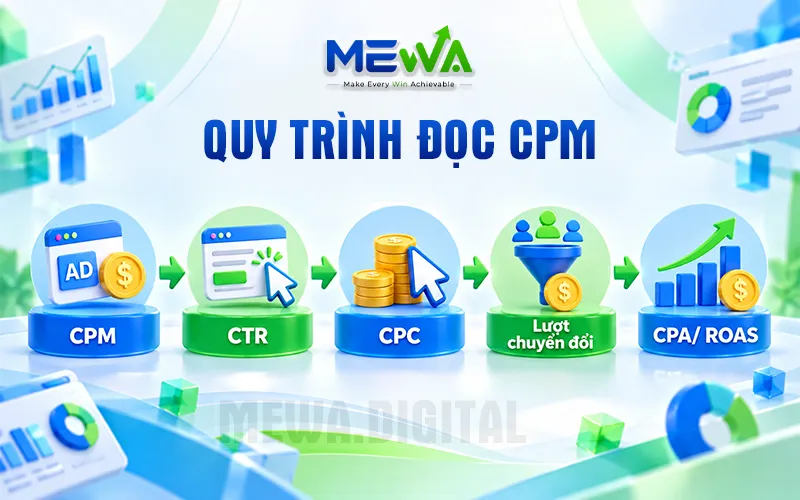
Evaluate through 5 steps:
- Step 1: Check CPM
→ Is the cost per impression increasing or decreasing? - Step 2: Check CTR
→ Are users engaging with the ad? - Step 3: Check
- CPC
→ How much does a single click cost? - Step 4: Check Conversions
→ Are clicks generating leads or sales? - Step 5: Check CPA or ROAS
→ Ultimately, does the ad spend yield proportionate business results?
Tips to Optimize and Reduce CPM Costs
An excessively high CPM means you are wasting your advertising budget. Here are 5 CPM optimization techniques used by experts:

Optimize Target Audience
Do not target too broadly or too narrowly. Precise targeting improves your ad relevance score, prompting platform algorithms to distribute ads at cheaper CPM rates.
Invest in Creatives (Images & Videos)
Engaging content boosts your Click-Through Rate (CTR). Platforms like Facebook and TikTok always prioritize lowering CPMs for content that retains users well. Improve content details such as:
- Hooks
- Headlines
- Messaging
- CTAs
- etc.
Control Impression Frequency
Do not let a single user see an ad more than 3–5 times per week. An overly high frequency causes ad fatigue, lowers CTR, and drives CPM up.
Conduct A/B Testing
Continuously test different audience segments, headlines, images, and video formats to identify the top-performing ad creative. While this approach takes more time, the results delivered are highly optimized and extremely effective.
Choose Peak Times to Launch Campaigns
Timing is another crucial factor marketers should consider. If your budget is limited, avoid running broad reach campaigns during peak competition periods (such as Black Friday or Lunar New Year).
FAQ – Frequently Asked Questions About CPM

What is CPM? What is CPM in ads? MEWA has answered these questions above. However, many people still have lingering questions about related issues. Below are answers to frequently asked questions to help you better understand and evaluate CPM.
1. What is a good CPM?
There is no fixed CPM rate considered “good” across all campaigns. CPM depends on the platform, industry, target audience, timing, and level of competition.
2. Does a high CPM mean the ad is performing poorly?
Not necessarily. CPM only reflects the cost to generate 1,000 impressions; it does not directly indicate whether the ad generates leads or revenue. A campaign with a high CPM can still be effective if it delivers strong CTR, conversion rates, and ROAS.
3. Does a low CPM mean the ad is performing well?
No. A low CPM simply indicates that the cost per impression is low. If the ad receives few clicks, has a low conversion rate, or fails to generate revenue, the campaign still hasn’t achieved its desired performance.
4. Why does CPM increase?
CPM can rise due to higher ad competition, an overly narrow audience segment, timing, industry sector, or ad delivery performance. When CPM increases, review CTR, CPC, frequency, and conversion rates before making optimization decisions.
5. How can you lower CPM?
You can test different audience segments, ad copy, images/videos, and ad placements to find options with better delivery costs. However, do not focus solely on reducing CPM. If CPM decreases while CTR or conversions also drop, the campaign isn’t necessarily performing better.
Conclusion
Understanding what is CPM and the true nature of this metric helps you proactively allocate your advertising budget smartly. Through this article, you have mastered the CPM formula, its pros and cons, how to distinguish CPM from other metrics, and how to analyze CPM to evaluate campaign performance.
