



If you are a shop owner on platforms such as Shopee, TikTok Shop, an Affiliate marketer, a Dropshipper, or someone selling products through social media, keeping up to date with e-commerce platform tax regulations is mandatory to optimize costs and avoid legal risks.
This article by MEWA summarizes all the latest regulations, tax rates, and detailed tax filing and payment procedures in the easiest-to-understand way. Read on!
Is it mandatory to pay tax when selling on an e-commerce platform?

Yes, selling on e-commerce platforms (Shopee, Lazada, TikTok Shop) requires you to pay tax if you fall within the category of taxable revenue.
E-commerce tax law: Clause 2, Article 4 and Clause 2, Article 8 of the Law on Tax Administration No. 38/2019/QH14, together with the new regulations on e-commerce tax administration updated in 2026.
Revenue threshold subject to e-commerce platform tax
According to Decree No. 141/2026/ND-CP on tax policies for business households and individuals and corporate income tax, the current mandatory taxable revenue threshold for conducting business on e-commerce platforms is over VND 1 billion/year.
Revenue used to calculate e-commerce platform tax is determined based on the revenue generated from each order, including the total amount of goods, shipping fees, and subsidies from the platform or amounts paid by the buyer.
Note: The Tax Authority does not base its calculation on the actual amount transferred to the seller’s bank account after the platform has deducted service fees or commissions.
For example, an order has:
- Product price: VND 480,000
- Shipping fee: VND 30,000
- Platform-funded voucher: VND 40,000
Although the seller actually receives only approximately VND 455,000 after deducting fees, the revenue used to calculate tax is still determined based on the revenue generated from the order under current regulations, rather than the amount transferred to the seller’s account.
Penalties for violations of e-commerce platform tax laws
Many sellers who neglect to register for tax or intentionally underreport revenue may face strict sanctions.
- Penalty for late submission of tax returns: From VND 2,000,000 to VND 25,000,000, depending on the number of days of late submission (under Article 13 of Decree No. 125/2020/ND-CP).
- Late payment interest: The late payment interest rate is 0.03% per day calculated on the total amount of overdue tax (under Clause 2, Article 59 of the Law on Tax Administration No. 38/2019/QH14).
- Penalties for tax fraud and tax evasion: A penalty of 1 to 3 times the amount of tax evaded applies to individuals/business households. In cases involving large-scale violations, criminal prosecution may apply (under Article 17 of Decree No. 125/2020/ND-CP and Article 200 of the 2015 Criminal Code, as amended in 2017).
5 new points in the 2026 e-commerce platform tax regulations
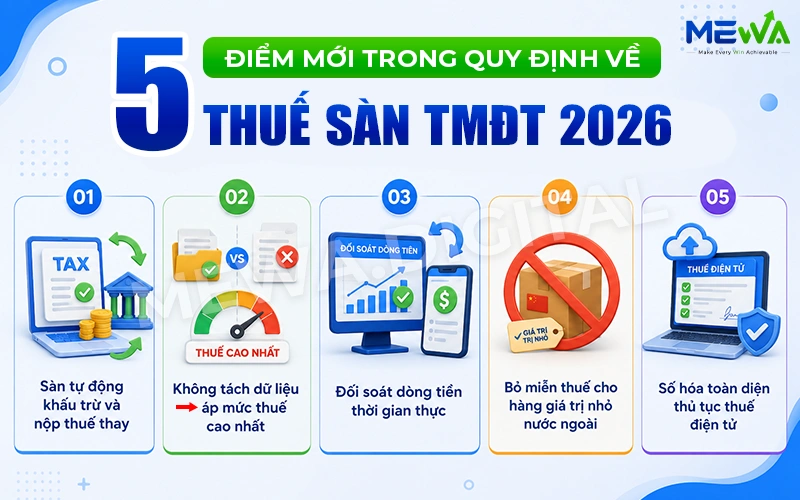
Entering 2026, the legal framework for e-commerce platform tax has undergone breakthrough changes aimed at tightening management and increasing market transparency.
Legal basis e-commerce platform tax 2026:
- Law on Tax Administration (amended and supplemented);
- Government Decree No. 117/2025/ND-CP;
- Circular No. 40/2021/TT-BTC of the Ministry of Finance;
- Government Decree No. 126/2020/ND-CP.
1. E-commerce platforms automatically withhold and pay tax on behalf of sellers
E-commerce platforms with payment functions (Shopee, Lazada, TikTok Shop, etc.) directly withhold, declare, and pay on behalf of individuals/business households the VAT (1%) and PIT (0.5%) on each successful transaction.
The system will automatically offset the e-commerce platform tax already withheld against the next period if an order is canceled or returned.
Note: The ability to pay e-commerce platform tax on behalf of sellers only applies to platforms with payment functions; on other platforms, sellers must still file their taxes themselves.
2. The highest tax rate applies if data is unclear
Individuals conducting business across multiple sectors on e-commerce platforms are required to clearly separate revenue for each field.
If the data cannot clearly distinguish the nature of the transactions, the platform will apply the highest e-commerce platform tax rate among the seller’s business sectors for withholding purposes.
3. Real-time cash flow reconciliation
The Tax Authority directly connects data with the systems of e-commerce platforms and banks. Any act of splitting revenue across multiple personal accounts to avoid e-commerce platform tax will be detected very quickly by the AI system.
4. Elimination of tax exemptions for low-value cross-border goods
The tax exemption policy for low-value orders from abroad shipped through cross-border e-commerce platforms is terminated, helping create fair competition for domestic goods.
5. Comprehensive digitization of electronic tax procedures
The entire process of registration, checking withholding certificates, and updating identification information for preparing tax returns and paying e-commerce platform tax can be completed online by sellers through the General Department of Taxation’s electronic information portal (thuedientu.gdt.gov.vn).
What are the tax rates on e-commerce platforms?
Tùy thuộc vào ngành nghề và mô hình hoạt động, mức thuế sàn thương mại điện tử áp dụng trực tiếp trêDepending on the business sector and operating model, the e-commerce platform tax directly applied to gross revenue is specifically regulated by the Law and detailed guiding documents:
- Point b, Clause 1, Article 3 and Clause 2, Article 4 of Circular No. 40/2021/TT-BTC of the Ministry of Finance (providing detailed regulations on the percentage rates calculated on revenue for business households and individuals).
- The current Law on Value-Added Tax and Law on Personal Income Tax (applicable to corporate legal entities).
Below is specific information on the tax rate table and tax calculation formulas.
VAT & PIT rates by business sector
Below is a quick reference table of Value-Added Tax and Personal Income Tax rates by specific business sector on e-commerce platforms (under Appendix I – List of business sectors and tax rates calculated on revenue issued together with Circular No. 40/2021/TT-BTC):
| Business Sector / Activity | VAT Rate | PIT Rate | Total Tax Rate / Revenue |
| Retail and distribution of goods (Fashion, household goods, cosmetics) | 1,0% | 0,5% | 1,5% |
| Online services, training, consulting | 5,0% | 2,0% | 7,0% |
| Advertising, Affiliate Marketing, Dropshipping | 5,0% | 2,0% | 7,0% |
| Transportation and services associated with goods | 3,0% | 1,5% | 4,5% |
Formula for calculating e-commerce platform tax payable
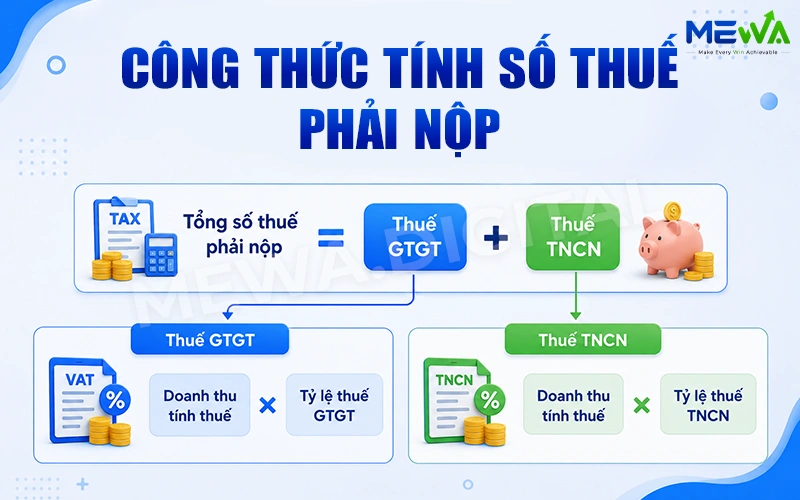
According to Clause 1, Article 10 of the Law on Tax Administration No. 38/2019/QH14 and Circular No. 40/2021/TT-BTC, the total e-commerce platform tax payable is the sum of VAT and PIT:
Total tax payable = VAT + PIT
VAT calculation formula
Legal basis: Point a, Clause 2, Article 4 of Circular No. 40/2021/TT-BTC.
For individuals and business households selling goods on e-commerce platforms, the VAT payable is determined using the following formula:
VAT payable = Taxable revenue × VAT rate
Where:
- Taxable revenue is the entire amount of sales revenue received by the seller before deducting expenses such as platform fees, shipping fees, advertising, or promotions.
- VAT rate is applied according to the business sector as prescribed by law.
PIT calculation formula
Legal basis: Point b, Clause 2, Article 4 of Circular No. 40/2021/TT-BTC.
After determining the taxable revenue for e-commerce platform tax, the personal income tax payable is calculated using the following formula:
PIT payable = Taxable revenue × PIT rate
Where:
- Taxable revenue is determined similarly to the calculation of VAT.
- PIT rate varies depending on the business sector.
Example: During the month, Shop A on TikTok Shop has 1,000 successful orders with a total order value (including shipping fees and subsidized vouchers) of VND 100,000,000.
- VAT payable: 100,000,000 × 1% = VND 1,000,000
- PIT payable: 100,000,000 × 0.5% = VND 500,000
Therefore, the total e-commerce platform tax payable is VND 1,500,000.
3 methods for filing e-commerce platform tax
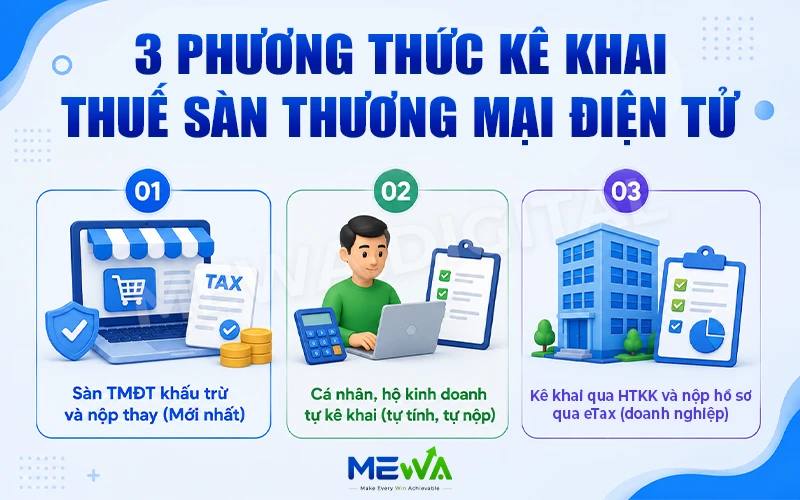
Depending on the scale and business model, online sales activities currently apply 3 flexible tax filing methods: e-commerce platform withholding and payment on behalf of sellers, self-filing by individuals and business households, and filing via HTKK – submitting tax returns via eTax
Legal basis:
- Article 42 of the Law on Tax Administration No. 38/2019/QH14 stipulates the principles of tax declaration and payment.
- Decree No. 126/2020/ND-CP and Decree No. 117/2025/ND-CP provide detailed regulations on electronic tax filing methods, tax return submission deadlines, and the mechanism for allocating responsibility for tax declaration/withholding on behalf of sellers through e-commerce platforms.
E-commerce platform withholding and payment on behalf of sellers (Latest)
- Applicable subjects: Individuals and business households operating on e-commerce platforms with payment functions (Shopee, TikTok Shop, Lazada).
- Mechanism: The platform automatically withholds, declares, and pays tax obligations on behalf of sellers (VAT 1%, PIT 0.5%) for each successful transaction. Sellers do not need to carry out tax filing procedures for these orders, and the system will also automatically offset the amount when an order is returned.
Individuals and business households filing their own taxes (self-calculation and self-payment of e-commerce platform tax)
- Applicable subjects: Individuals and business households operating on platforms without payment functions or selling through social media and their own websites.
- Method: Consolidate all actual revenue and file online using Form 01/CNKD on thuedientu.gdt.gov.vn (INDIVIDUAL module).
- Deadline: No later than the 20th day of the following month (if filing monthly), or no later than the 10th day in cases where a tax obligation arises for each transaction.
Filing via HTKK and submitting tax returns via eTax (for businesses)
- Applicable subjects: Business legal entities (limited liability companies, joint-stock companies) selling through e-commerce channels.
- Method: File e-commerce platform tax as a normal business through the HTKK software and submit tax returns through the eTax system.
- Obligations: Declare VAT using the credit-invoice method (Form 01/GTGT), account for eligible expenses to calculate Corporate Income Tax (CIT) quarterly/annually, and issue electronic invoices to buyers as required.
Online process for filing, checking, and paying e-commerce platform tax
Legal basis:
- Circular No. 19/2021/TT-BTC of the Ministry of Finance guiding electronic transactions in the tax sector.
- Law on Tax Administration No. 38/2019/QH14 stipulating taxpayers’ obligations to retain tax records and documents.
The process of filing, checking data, and paying e-commerce tax obligations is completed entirely online through the following simple steps.
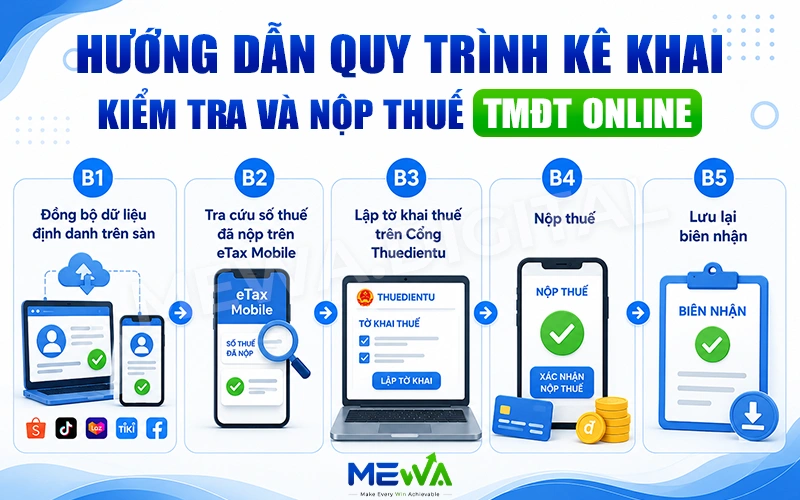
Bước 1 – Đồng bộ dữ liệu định danh (KYC) trên sàn TMĐT
Bước 2 – Tra cứu số thuế sàn thương mại điện tử đã nộp trên eTax Mobile
Bước 3 – Kê khai thuế thương mại điện tử qua Cổng thông tin điện tử Tổng cục Thuế
– Truy cập cổng thuedientu.gdt.gov.vn, đăng nhập tài khoản bằng tài khoản VNeID hoặc mã số thuế cá nhân -> Chọn Tờ khai mẫu 01/CNKD và điền đầy đủ thông tin.
– Sau đó tải file đối soát doanh thu lên hệ thống và tiến hành ký điện tử để nộp tờ khai cho cơ quan thuế.
Bước 4 – Nộp thuế sàn thương mại điện tử qua ứng dụng eTax Mobile
Bạn chỉ cần kiểm tra danh sách các khoản thuế phải nộp, lựa chọn nguồn tiền từ tài khoản ngân hàng đã liên kết và tiến hành xác thực giao dịch để hoàn tất lệnh nộp tiền vào Ngân sách Nhà nước.
Bước 5 – Lưu trữ chứng từ điện tử
- Step 1 – Synchronize identification data (KYC) on the e-commerce platform
Sellers log in to the Seller Center of the e-commerce platforms, then proactively update their Citizen Identity Card (CCCD), personal tax identification number, or business household tax identification number accurately.
- Step 2 – Check e-commerce platform tax paid via eTax Mobile
Sellers download the eTax Mobile application (of the General Department of Taxation) → Log in using their VNeID account. Go to Taxpayer Information Lookup to accurately check the amount of tax that the platforms have withheld and paid on their behalf during the period.
- Step 3 – File e-commerce tax through the General Department of Taxation’s electronic information portal
For independent business activities outside e-commerce platforms or on platforms that do not support withholding and payment on behalf of sellers, sellers need to prepare an e-commerce platform tax return through the General Department of Taxation’s electronic information portal by:
– Accessing [thuedientu.gdt.gov.vn], logging in using a VNeID account or personal tax identification number → Select tax return Form 01/CNKD and complete all required information.
– Then upload the revenue reconciliation file to the system and proceed with electronic signing to submit the tax return to the Tax Authority. - Step 4 – Pay e-commerce platform tax via the eTax Mobile application
Sellers make payments for their financial obligations directly on their smartphones through the eTax Mobile application.
You only need to check the list of taxes payable, select the funding source from the linked bank account, and authenticate the transaction to complete the payment order to the State Budget. - Step 5 – Store electronic documents
Shop owners should proactively download and fully retain Receipts for payments to the State Budget and Electronic Tax Withholding Certificates issued by the platforms. The minimum retention period is 10 years to support reconciliation when requested by the Tax Authority.
Frequently asked questions about e-commerce platform tax

A summary of frequently asked questions regarding financial obligations and tax withholding mechanisms on e-commerce platforms – a detailed Q&A section specifically for sellers.
1. The platform has already paid the tax on my behalf. Do I still need to file a tax return myself?
No, if you only sell on e-commerce platforms. If you also sell outside the platforms or operate under a business model, you must file the tax return for that revenue yourself.
2. Are returned/refunded or canceled orders subject to tax?
No. Tax is only calculated on successfully delivered orders. Canceled or returned/refunded orders will be automatically deducted by the platform’s system, and the tax amount already withheld will be refunded to the Seller Wallet.
3. If I sell at a LOSS on the platform, do I still have to pay 1.5% e-commerce platform tax?
It depends on the type of business entity you are. If you are:
- Individual / Business household: MUST PAY. Tax is assessed at 1.5% of gross revenue; even if you sell at a loss, you must still pay the tax.
- Business: NO NEED TO PAY. CIT is calculated based on net profit (Revenue – Expenses). If the business operates at a loss, no CIT is payable.
4. Where can I obtain the e-commerce platform tax withholding certificate from Shopee/TikTok Shop?
- On Shopee: Go to Finance → select Tax Center → select Tax Certificate → download the PDF file with a valid digital signature from the platform.
- On TikTok Shop: Go to Finance → select Invoices & Tax Documents → filter by the filing period and download the tax withholding certificate in PDF format.
5. If I use a personal bank account, can the Tax Authority trace it?
Yes. Banks are responsible for automatically sharing cash flow data with the Tax Authority. The AI system will automatically reconcile cash flows into accounts with revenue declared on the platforms to detect discrepancies.
6. If the platform pays taxes on my behalf from 2026, will revenue from previous years (2023–2025) be subject to tax collection?
Possibly. Payment on behalf of sellers by the platforms only applies to the current period. Revenue from previous years for which taxes have not been paid may still be extracted for review, and the statutory period for tax collection may be up to 10 years.
Conclusion
Understanding the regulations on E-commerce platform tax not only helps you comply with the law but also enables you to proactively calculate your product profit margins. Proactively standardize your identification information on the platforms and use the eTax Mobile application to monitor your tax cash flows in the most transparent manner.
