



In the face of continuous Google algorithm updates, publishing isolated, random articles no longer helps you reach the top of search results. To achieve a breakthrough on Search Engine Result Pages (SERPs), you need to understand what is SEO content and how to structure your content system strategically.
Let’s explore the concept of SEO content with MEWA, learn how to leverage content pillars and content angles strategies to build domain authority, and discover key criteria for choosing cost-effective SEO content writing services.
What Is SEO Content?
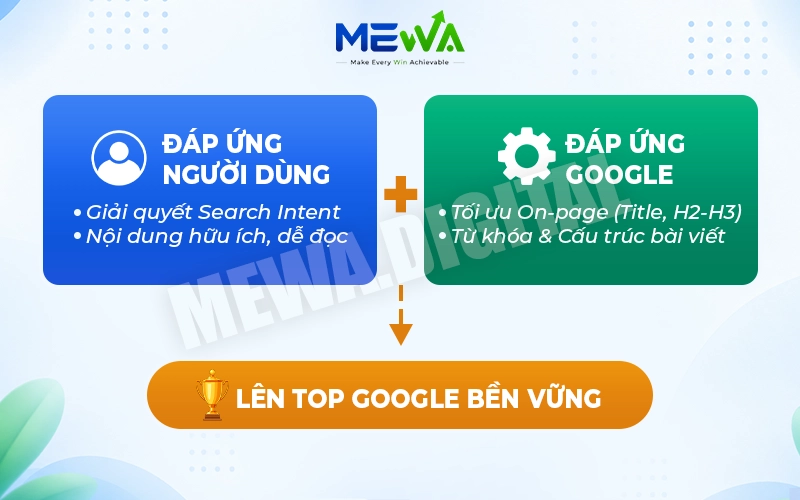
What is SEO content? SEO content refers to web content that is researched, created, and optimized to fulfill two main goals: addressing user search intent and satisfying search engine (like Google) technical standards to secure high rankings on SERPs.
Why Must Your Website Invest in SEO Content?
Investing in high-quality SEO content yields sustainable, long-term business benefits:
- Reduce Advertising Costs: Decrease reliance on paid ads (PPC) through steady organic traffic.
- Reach the Right Audience: Users who search for specific keywords already have a real demand for your products or services.
- Build Brand Authority: Appearing consistently at the top of Google search results establishes strong trust with consumers.
Core Elements of an SEO-Standard Article
A great SEO article requires not only engaging copy but also a technically sound On-page structure. Here are the core elements you must optimize:
Keyword Research and Search Intent Analysis
Keywords bridge the gap between user queries and your content. While research helps identify primary, secondary, and LSI keywords, understanding search intent is the real game-changer.
Search intent falls into 4 main categories:
- Informational: Seeking knowledge (e.g., what is seo content).
- Navigational: Looking for a specific brand or site (e.g., WordPress login).
- Commercial: Comparing options before buying (e.g., top seo content writing services).
- Transactional: Ready to purchase (e.g., pricing for seo content writing services).
On-Page Structure Optimization
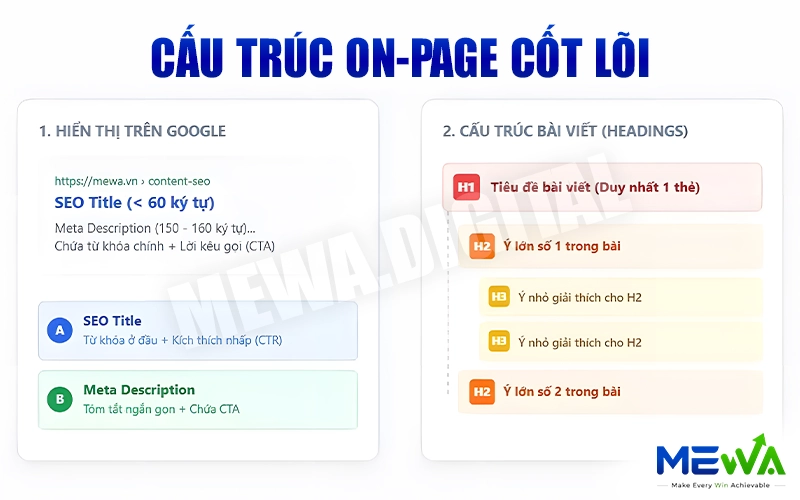
On-page elements help search engines understand your main topic and rank relevance:
- SEO Title: Visible directly on SERPs. Keep it under 60 characters, place the primary keyword near the front, and craft a compelling hook to boost Click-Through Rate (CTR).
- Meta Description: A 150–160 character summary containing primary/secondary keywords and a clear Call to Action (CTA).
- Heading Tags (H1, H2, H3…): Establish logical hierarchy. Use one H1 tag for the main title, H2s for major sections, and H3s for supporting sub-points.
User Experience (UX Content) and Depth
Online readers scan content. Improve readability and UX by:
- Using short sentences and brief paragraphs (2–3 lines).
- Highlighting key points with bolding, italics, or bullet lists.
- Providing in-depth, accurate answers to user queries instead of adding fluff to inflate word count.
Shifting to a Strategic Content System Mindset
Optimizing individual articles is essential, but it isn’t enough to beat established competitors. To secure lasting rankings, you must shift from writing standalone posts to creating interconnected content ecosystems.
The Risks of Isolated Publishing
Publishing disconnected articles leads to several pitfalls:
- Low Topic Authority: Google’s algorithms cannot gauge your website’s overall expertise in a niche.
- High Bounce Rates: Readers leave quickly without finding related articles to explore next.
- Diluted Link Equity: Internal link value (Link Juice) isn’t concentrated on your high-priority pages.
Core Benefits of Topic Clusters
Structuring content into topic clusters yields dual advantages:
- For Users: They find a comprehensive solution to their problem in one place.
- For Google: Crawling becomes easier, content hierarchy is clear, and topical authority rises.
The most effective way to implement this strategy is by building a Topic Cluster model around a Content Pillar, supported by surrounding Cluster Content.bài viết thành từng cụm chủ đề (Topic Cluster ), lấy Content Pillar làm gốc rồi phát triển các Cluster Content xung quanh.
Strategic Framework: Content Pillars and Content Angles in SEO
The Topic Cluster model organizes posts via strong relationships between a core pillar page and supporting cluster pieces.
What Is a Content Pillar?
A Content Pillar is a comprehensive, in-depth guide covering all subtopics of a broad subject. Pillar pages are usually lengthy (2,000–5,000 words) and target competitive, high-volume keywords.
How Topic Clusters Connect Pillar Pages and Cluster Content
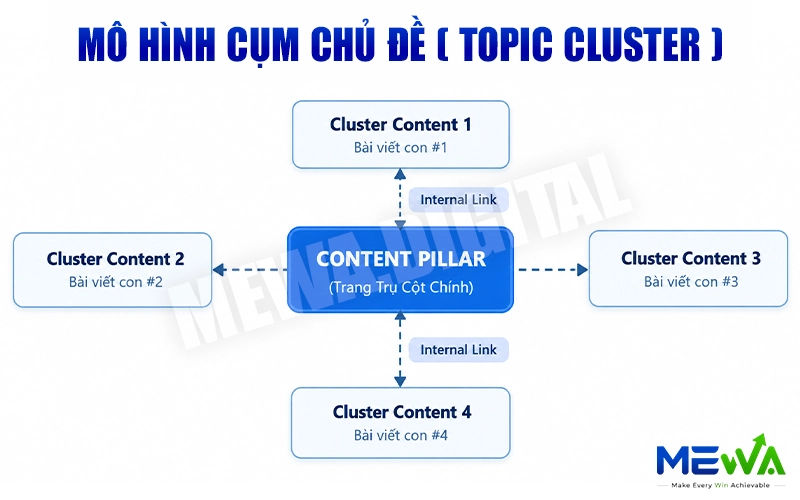
This model relies on a two-way internal linking structure:
- Pillar Page: Sits at the center, offering a complete overview of the core topic.
- Cluster Content: Dives deep into specific subtopics mentioned on the pillar page.
- Internal Links: Cluster articles link back to the pillar page, and the pillar links out to clusters.
Building Topical Authority
When you cover every question around a core topic using cluster content that links back to a pillar, Google recognizes your site’s Topical Authority. This elevates rankings across your entire content network faster and more sustainably.
While a strong content pillar and content angle framework forms the structural backbone, you still need unique angles to stand out on crowded SERPs.người nhấp vào và vượt qua các đối thủ có cùng chủ đề, bạn cần trang bị vũ khí tiếp theo: Content Angle.
Leveraging Content Angle to Outrank Competitors
If a content pillar defines overall structure, a content angle provides the unique value that differentiates individual posts.
What Is Content Angle?
A content angle is the unique perspective or hook an author chooses when covering a keyword. For the same keyword, different content angles appeal to different target audience segments.
Example: For the keyword “weight loss”, potential angles include:
- Expert Angle: “A Nutritionist Explains Safe Weight Loss Protocols.”
- Practical Angle: “How I Lost 10 lbs in 30 Days Without Strict Dieting.”
5 Unique Angles to Outperform Competitors
To find a distinctive content angle, try these 5 approaches:
- Expert / Case Study Angle: Share real data and actual experience rather than generic theory.
- Quick / Minimalist Solution Angle: Target readers seeking fast results (e.g., “Optimize SEO Content in 30 Minutes”).
- Warning / Common Mistakes Angle: Appeal to risk avoidance (e.g., “7 SEO Content Mistakes tanking your rankings”).
- Comparison / Objective Review Angle: Offer multi-dimensional insights so readers can decide.
- Trends / Update Angle: Focus on the latest Google algorithm updates and industry standards
A 6-Step Workflow for Executing Effective SEO Content
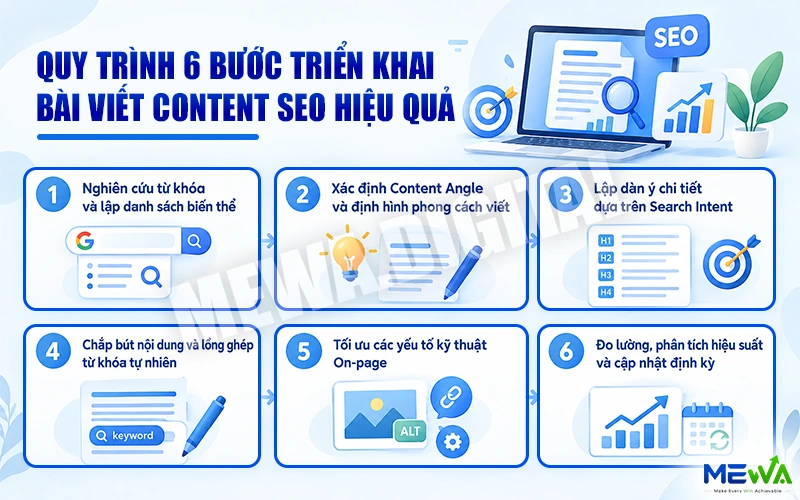
Once you understand what SEO content is and how to align a content pillar and content angle, follow this 6-step execution workflow.
- Keyword Research & Mapping
Use tools like Ahrefs, SEMrush, or Google Keyword Planner to find primary keywords, secondary phrases, and LSI terms.
- Define Content Angle & Tone
Analyze the Top 5 SERP competitors and pick an unexploited, unique angle.
- Draft a Search-Intent Outline
Build a logical heading framework (H1-H4) that answers common user queries.
- Draft & Naturally Integrate Keywords
Write concise, direct copy. Seamlessly place primary keywords in crucial spots (Title, H2, first 100 words, conclusion) while maintaining a natural density (1%–2.5%).
- Optimize Technical On-Page
Images: Compress file sizes (<150KB), use descriptive keyword-based file names, and fill out alt text.
Links: Add internal links connecting cluster articles and high-value service pages. - Measure, Analyze, and Update
Monitor performance via Google Search Console and GA4. Refresh content every 3–6 months to sustain rankings.
In-House Writing vs. Hiring Professional SEO Content Writing Services
Deciding whether to write in-house or partner with external agencies depends on your resources, team capacity, and business goals.
Pros & Cons of In-House Content Creation
- Pros: Deep understanding of your product, service, and brand voice.
- Cons: High training costs, potential lack of advanced SEO technical skills, and high fixed overhead.
Criteria for Selecting Reliable SEO Content Writing Services
If you choose to outsource, evaluate providers using these standards:
- E-E-A-T Compliance: Content is written or vetted by industry experts with verified, fact-checked information.
- Clear Keyword & Topic Cluster Strategy: They offer structural content planning rather than just delivering word counts.
- Quality & Originality Guarantees: Unique content (>90% original) with proper On-page optimization.
- Transparent Reporting: Clear metrics on On-page health and keyword ranking visibility.
Conclusion
Understanding what is SEO content and mastering a structured approach with a content pillar and content angle is key to sustainable search rankings.
If you want to save time and optimize costs, explore comprehensive seo content writing services provided by MEWA to elevate your website rankings today!
