


GEO is rapidly becoming one of the most critical digital trends as artificial intelligence fundamentally transforms how users search for information online. Instead of merely competing for top rankings on Google search result pages, modern businesses must optimize their content to be selected as primary reference sources by AI platforms like ChatGPT, Gemini, and Google AI Overviews.
So, what is GEO, how does it differ from traditional SEO, and what steps should businesses take to stay ahead of this wave? Let’s dive deep into the details with MEWA in the article below!
Overview of GEO (Generative Engine Optimization)
While users previously accessed websites primarily through traditional Google Search, many now prefer asking questions directly to AI models for faster, more comprehensive answers. This shift explains why Generative Engine Optimization has gained immense attention recently.
What is GEO?
GEO stands for Generative Engine Optimization. It refers to the strategic process of optimizing a website’s structure and content so that AI engines—such as ChatGPT, Google Gemini, Perplexity, and Copilot—can effortlessly crawl, analyze, and cite your information in their generated responses to users.
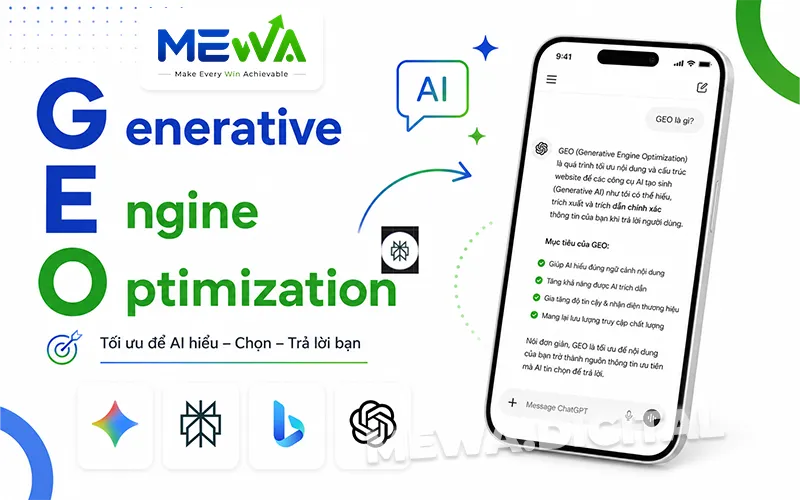
Unlike conventional search strategies aimed at securing top positions on search engine results pages (SERPs), GEO optimization focuses on establishing your brand or content as a trusted, authoritative data source that AI platforms prioritize as a reference.
How Does GEO Work?
Fundamentally, GEO operates by minimizing the Information Retrieval Cost (IRC) for AI language models. When a user enters a query, the AI scans millions of data sources, evaluating relevance and credibility to synthesize a single, cohesive answer.
This mechanism unfolds in three core steps:
- Querying and Data Scanning: The AI retrieves relevant content based on the contextual intent of the prompt.
- Evaluation and Extraction: The system filters out high-value information segments characterized by clear structure and high factual accuracy.
- Synthesis and Citation: The AI compiles the response and attaches citation links back to the source websites.
SEO vs GEO – What’s the Difference?
Although both strategies aim to elevate digital visibility, SEO vs GEO represent fundamentally distinct methodologies.
Understanding the differences between SEO vs GEO helps businesses build an optimization plan aligned with modern search behaviors:
| Comparison Criteria | SEO (Search Engine Optimization) | GEO (Generative Engine Optimization) |
| Target Entities | Traditional search engines (Google, Bing, Yahoo) | Generative AI models (ChatGPT, Gemini, Perplexity) |
| Returned Output | A list of 10 organic links per SERP | A single synthesized answer with embedded source citations |
| Core Objective | Rank high (Top 1–3) to drive organic clicks | Earn AI trust to be cited as an authoritative source |
| Primary Metrics | Keyword rankings, organic traffic, CTR | AI Citation frequency, AI brand exposure |
| Keyword Strategy | Focus on main keywords, short-tail terms, search volume | Focus on context, long-tail questions, in-depth intent |
Importance and Benefits of GEO for Businesses
The evolution in search behavior is no longer a future prediction—it is happening daily. Companies that fail to adapt proactively risk severe drops in organic traffic.
The Importance of GEO in the AI Era
Các nghiên cứu thị trường chỉ ra rằng lưu lượng tìm kiếm tự nhiên truyền thống đang giảm dần do sự xMarket research highlights a steady decline in traditional organic search volume due to the rise of Zero-Click Searches.
- Traditional Journey: User -> Google Search -> List of websites -> Clicks link -> Finds answer.
- Modern Journey: User -> AI Search -> AI synthesizes response -> Cites source (if applicable).
If your brand does not appear within AI-generated responses, you effectively become invisible to a massive segment of modern consumers. Consequently, adopting GEO optimization is essential for maintaining digital market presence and growth.
Key Benefits of GEO Implementation
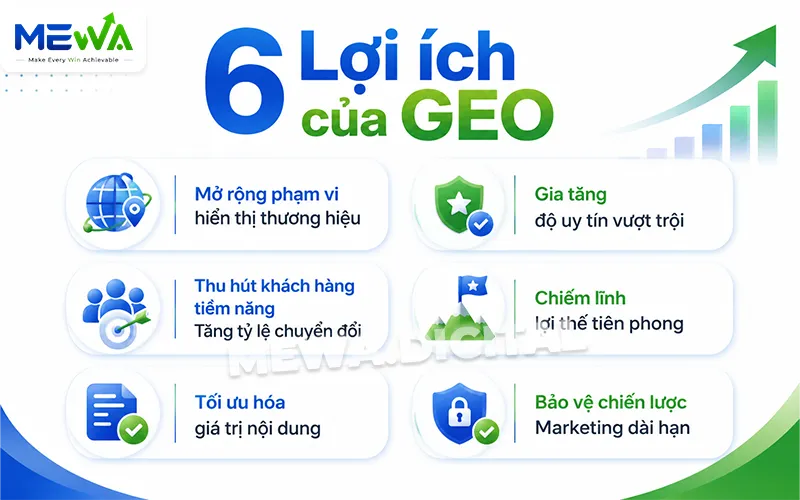
The benefits of GEO extend far beyond keeping pace with technology—integrating this strategy yields clear competitive advantages:
- Expanded Brand Exposure: Reach growing audiences shifting toward AI-first search habits.
- Elevated Credibility: Direct recommendations and citations from intelligent AI systems build immense trust with potential clients.
- High-Intent Lead Generation: Users searching via AI usually possess specific, high-converting purchasing intent.
- First-Mover Advantage: While competitors remain focused solely on traditional SEO, early adopters of Generative Engine Optimization secure strong data authority within AI knowledge bases.
- Maximized Content Value: In-depth, high-quality website articles achieve higher visibility instead of getting buried under search result pages.
- Future-Proofed Marketing Strategy: Protect your media and communication ecosystem against future technological disruptions.
How AI Models Select Content
To ensure your content is chosen by AI engines, you must understand their evaluation criteria. AI does not consume content like humans; it analyzes data signals via complex algorithms:
- Source Authority & Trustworthiness (E-E-A-T): AI prioritizes sites demonstrating deep expertise, clear authorship, transparent citations, and empirical data.
- Information Density: Text blocks rich in valuable facts that answer queries directly yield lower IRC scores, making them easier for AI to extract.
- Logical Content Structure: Content organized with question-based headings (H2, H3), bulleted lists, and tables allows Natural Language Processing (NLP) models to parse data seamlessly.
- Brand Mentions & Citations: Frequent brand presence across authoritative platforms, forums (Reddit, Quora), and news sites serves as proof of brand prominence.
- Data Consistency: Product, service, and company details must remain consistent across the web to prevent conflicting data during AI synthesis.
8 Deep-Dive GEO Optimization Techniques for Websites
Once you understand how AI selects information sources, the next step is implementing actionable GEO optimization tactics.
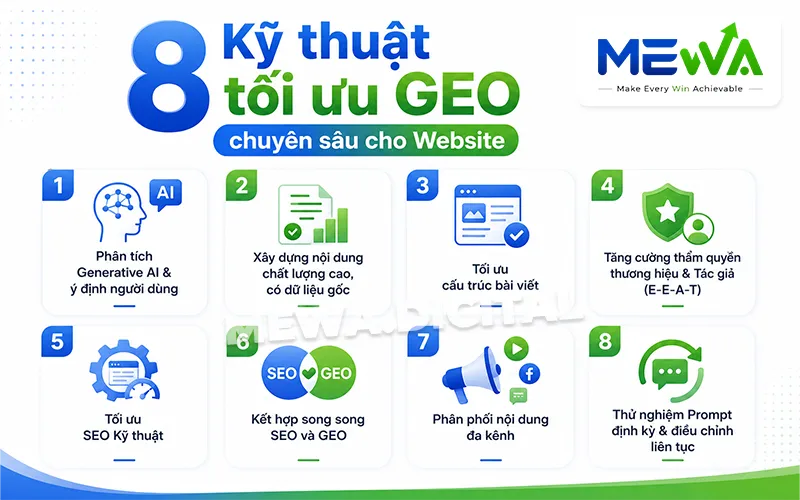
1. Analyze Generative AI & User Intent
Studying how Large Language Models (LLMs) like GPT, Gemini, and Claude answer questions is the foundation of effective content creation. Identify the long-tail conversational queries your audience inputs into AI tools to align your content directly with user intent.
2. Create High-Quality Content with Original Data
AI models favor primary data, proprietary research, and verified industry statistics. Incorporating statistics and verifiable facts lowers information uncertainty, boosting your site’s authority as a cited source.
3. Optimize Content Structure
AI parses structured data efficiently. Practice Early Query Answering (providing concise direct answers in opening paragraphs), use question-formatted subheadings (Q&A style), and include FAQ sections to help algorithms extract key takeaways effortlessly.
4. Strengthen Brand & Author Authority (E-E-A-T)
AI rigorously checks author profiles and brand authority. Transparently display expert credentials, hands-on experience, and author bios while maintaining consistent brand messaging across all digital channels.
5. Enhance Technical Infrastructure
Solid technical foundations are mandatory for AI crawlers. Alongside page speed optimizations and Schema Markup implementation, creating an llms.txt file in your root directory provides AI bots with a clean summary of your website structure.
6. Integrate SEO and GEO Strategies
SEO vs GEO should not be viewed as opposing approaches; they complement each other. Traditional SEO builds technical health and search engine indexing so AI can discover your content, while GEO ensures your content gets selected and cited in generative answers.
7. Multichannel Content Distribution
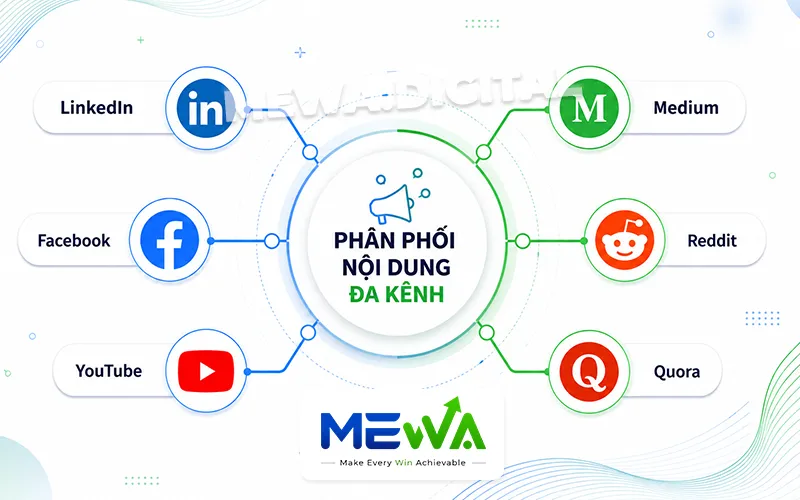
AI models learn from the broader web beyond your site. Distributing content across high-engagement platforms like Reddit, Quora, industry publications, and social media increases your brand presence and feeds data to AI networks.
8. Regular Prompt Testing & Iteration
AI algorithms update frequently. Run periodic prompt tests simulating customer queries to monitor whether your brand is being mentioned. Use these insights to continually refine your content structure and semantic optimization.
How to Measure Your GEO Optimization Performance
Unlike tracking static keyword rankings in traditional SEO, evaluating Generative Engine Optimization effectiveness requires flexible methods:
- Manual AI Query Testing: Ask industry-related questions across AI platforms to see if your brand appears in answers or citations.
- Monitor Referral Traffic: Check Google Analytics for incoming traffic from AI domains like chatgpt.com or perplexity.ai.
- Utilize Specialized Measurement Tools: Leverage AI tracking platforms like Goodie AI or Semrush Enterprise AIO to measure your domain’s AI Citation Frequency.
- Track Branded Search Volume: As AI mentions your brand more frequently, users naturally search for your brand directly on Google to verify, causing a lift in branded search queries.
Why Choose MEWA for Your GEO Strategy?
In a rapidly changing search landscape, businesses need more than conventional SEO tactics. MEWA provides end-to-end Generative Engine Optimization solutions to maximize your visibility across AI search platforms.
Partnering with MEWA for GEO optimization delivers:
- Structured GEO Roadmap: Combining traditional search strategies with AI Search Optimization to boost citations.
- Comprehensive Website Optimization: Refining Technical SEO, Schema Markup, Entity SEO, and AI-ready content structures.
- Digital Brand Building: Increasing Brand Mentions and domain trust across high-authority web platforms.
- Integrated Ecosystem Support: Connecting solutions across MESEO, MEDESIGN, MEADS, MEAFF, and MESHOP to support end-to-end growth.
- Continuous Testing & Optimization: Auditing AI visibility and adapting strategies based on real-time data.
Conclusion
AI Search is reshaping how audiences consume information, introducing new requirements for digital content strategies. Investing early in GEO positions your brand to secure citations within AI-generated responses, reinforcing trust and expanding market reach. Combining GEO optimization with a strong SEO foundation is the ultimate strategy to thrive in the modern era of search engine intelligence.
